
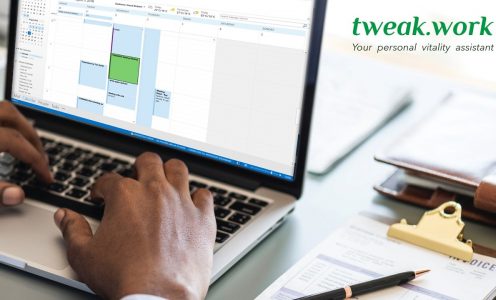

In this project, we developed a calendar-based health-promotion tool that integrates into the Outlook Calendar of office employees. Through personalisation and smart timing systems, we investigated if integrating health-promotion messages in office-tools such as the calendar was an effective intervention medium. We hosted many exploratory brainstorming sessions with office employees and leveraged co-design processes to come up with design requirements. We implemented a back-end system that would ingest many data input sources, such as wearables, calendar-data, survey results and more. The system would process the data and come up with the most relevant health promotion message and find a good spot in the users calendar to create an event. The system would learn from user feedback and become more relevant to users preferences over time. We evaluated this system with 24 users in 2 companies over 4 weeks in a mixed methods fashion. Using both qualitative methods (thematic analysis) and quantative results (system data and survey results) we analysed the output and published a paper on its results on the European Conference on Cognitive Ergonomics [link].

Design Process
This 1-year project started with a participatory design process, heavily involved stakeholders and end-users from the beginning. Through co-creation sessions, focus groups and in-depth interviews we derived a rich understanding of ‘Office Vitality’ – how people manage their wellbeing in a work-context. Based on this, we created design requirements and brainstormed concepts that would fit the requirements and would be feasible to implement as a probe. We developed ‘Tweak.work’ together with a development agency (kudos to Bureau Moeilijke Dingen!) that would algorithmically select textual prompts from a database based on a fusion of sensor and survey data. This led to a personalized prompting system, that could also adapt over time. By integrating into existing systems such as Outlook, we reduce the adoption curve and novelty effects, and gain better insights into how the calendar might act as a delivery system for prompts. We conducted pre- and post surveys and interviews, analysed by means of a thematic analysis and data analysis, and found effects that were later on used by stakeholders to improve their own commercial digital systems.
Design Activities
- Ideation Processes
- Various brainstorming methods with and without stakeholders
- Co-Creation sessions and Focus Groups (n>20)
- System Development
- Overall system design & algorithm
- API integrations (weather, calendar, fitbit, jotform)
- Content of prompts – collaboration with healthcare experts
- Outlook integration
- User Testing
- Set up multiple user tests in 2 organisations (n>20)
- Onboarding sessions and documentation
- Involvement of CISO & Data Protection Officers
- Consent Forms & Ethical Reviews
- Execution of user tests, monitoring and evaluation
- Academic Literature
- Concept Development and project vision based on HCI literature
- Benchmarking of existing systems and products
- Publication of full paper on results at international HCI conference (ECCE)
- Project Management
- Coordinated various stakeholders (Zilveren Kruis, Heijmans, TU/e, Philips)
- Managed Work Packages, KPI’s and Deliverables
- Wrote the reports and documentation
- Created Business value propositions